
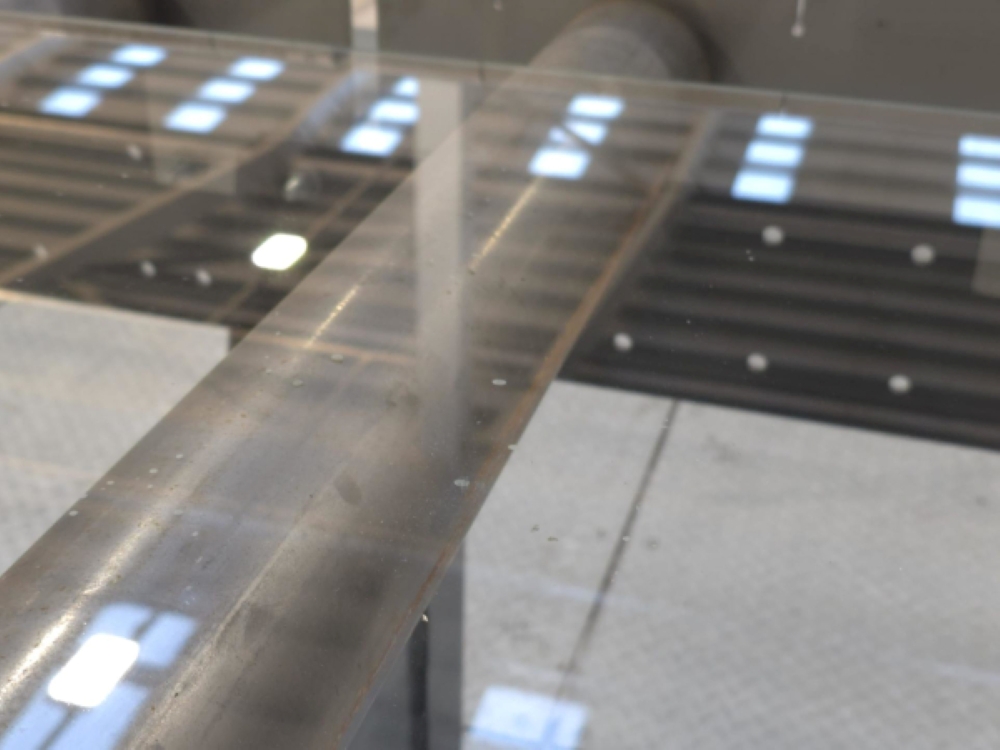
i3D Robotics completed a project to leverage smart vision and sensory technology to detect tiny defects during flat glass production and potentially help reduce the flat glass industry’s carbon emissions by 20,000 tons annually and minimize waste from destructive testing.
The project, “Intelligent Robotic Inspection for Foundation Industry Optimization” (IRIFIO), was conducted on Glass Futures’ new pilot line in St. Helens, England. Glass Futures officials note that glass defects can lead to significant costs, and current detection methods are energy-intensive and time-consuming. Detecting inclusions in glass could eliminate the need for heat soaking thousands of panels before tempering.
“I’m proud to share that we completed the first cold trial on Glass Futures’ pilot line for the IRIFIO project,” says Daniel Backhouse, senior glass technologist at Glass Futures. “It was an exciting process, moving samples under the IRIFIO camera system to see how it performs in industrial conditions. We gathered valuable data that our project partners will now analyze. We look forward to continuing to collaborate with our partners to further develop and scale this technology for the glass industry.”
According to officials, the project identified microscopic defects during production, which were smaller than the 150 microns existing scanners can detect and far beyond what manual inspection can spot. Implementing the defect detection technology could save tempered glass suppliers around $2 million by eliminating the heat soaking process and preserving 11,000m³ of glass that would otherwise be discarded as false positives.
The Science and Technology Facilities Council Hartree Centre managed the project. Collaborators include glass manufacturing supply chain consultants Glass Technology Services and international materials consultancy Lucideon.
To help get the project on its feet, IRIFIO received $5 million in funding from the United Kingdom Research and Innovation’s Transforming Foundation Industries (TFI) challenge and the TFI Fast Start competition.